Book Review

By | Thoughts

Orwell: The New Life by D. J. Taylor

My rating: 4 of 5 stars

Never Meet Your Heroes

A deeply researched and engagingly written portrait of arguably the twentieth century’s most iconic literary figure. Yet by the end, one is left with a troubling impression: George Orwell, the great defender of truth and decency, wasn’t a particularly decent man himself. D. J. Taylor does not avoid this reality, but for this reader the conclusion was unavoidable: Orwell is a hero I’m glad I didn’t meet.

What emerges most clearly from Taylor’s portrait is Orwell’s almost sociopathic tendency for fitting people into categories. Whether aristocrats, intellectuals, or working-class comrades, Orwell had a penchant for reducing individuals to ‘types’, often accompanied by a withering judgment. Which suggests a man more interested in ideas than in people, a contradiction that makes Orwell’s social commentary paradoxically astute and emotionally distant.

Orwell’s treatment of women is especially unsettling. His first wife, Eileen, is largely absent from his letters until her health declined, a silence that suggests emotional detachment rather than oversight. Even during their courtship, Orwell frequently misspelled her name – a small but telling sign of inattentiveness. Taylor subtly underscores this pattern, and the portrait that emerges is of a man either unable or unwilling to engage with the emotional reality of those closest to him.

More troubling still are repeated references to Orwell’s inappropriate sexual advances. Taylor recounts episodes where Orwell would often “jump” on unsuspecting female acquaintances, and his coy suggestions to “go for a walk in the woods” present little ambiguity. These incidents are disturbing not only in themselves, but because they stand in stark contrast to Orwell’s public posture as a principled critic of coercion and abuse of power.

Then there are the ideological inconsistencies. Orwell, the avowed pacifist “enjoying the fighting” during the Spanish Civil War; Orwell, the brilliant diagnostician of totalitarianism, predicting that the British Home Guard would rise up against its own government; Britain falling to the same working-class after WWII was won. Orwell’s dystopian imagination might have been unmatched, but his real-life foresight was clearly a miss.

And yet, despite these contradictions – perhaps even because of them – Orwell: The New Life is a compelling read. Taylor’s prose is elegant, if occasionally too clever for its own good. Words like “sedulous”, “amanuensis”, and “querulous” cropped up often enough to send this reader scrambling for a dictionary. It’s a curious stylistic choice, considering Orwell’s own disdain for obscure or pretentious language. As a biographer and admirer of Orwell, Taylor’s departure from that principle feels oddly inconsistent.

The book also reads like a literary Who’s Who of early twentieth-century Britain. Taylor name-drops nearly every major writer and critic of the period, reminding us that despite cultivating the image of a down-at-heel outsider, Orwell benefited from an elite connection well in keeping with his Old Etonian pedigree. It’s fair to ask whether Animal Farm and Nineteen Eighty-Four would have achieved such cultural permanence without the well-placed support of this rarefied circle.

Ultimately, Taylor succeeds in humanising Orwell, but at a cost. The more vivid and intimate the portrait becomes, the harder it is to ignore the great dystopian author’s flaws. You may come away from this book with a deeper understanding of George Orwell the writer, but continuing to admire Eric Blair the man is a different matter.
View all my reviews


Book Review: Homage to Catalonia

By | Thoughts

Another Orwell book that has left me with mixed feelings.

Not that I was expecting my favourite dystopian author’s personal experience of the Spanish Civil War to be historically accurate, or the prose was lacking in some way. No, it’s the faint whiff of ‘pull up a sandbag’ about the account.

My fellow veterans will know what I’m talking about – there was something not quite right about the recollections, some of which, for me, tipped dangerously towards ‘stolen valour’ territory.

For example, why mention being in hand-to-hand combat ‘only once’ without elaborating on the ordeal? Fighting with just a knife or one’s bare hands is not something quickly forgotten. And no, chasing one of Franco’s soldiers through a trench system, bayonets fixed, doesn’t count. ‘We were ordered not to shoot’. Really? With the raid in full swing, the target in plain sight and the enemy unlikely to be fighting under the same rules of engagement? Hmmm.

Not that Orwell needed to do a Hemingway and embellish his wartime experiences. Personally, I would be dining out on surviving a bullet through the neck every chance I got, even if it was my own stupid fault. Indeed, it is the frankness of this account that makes the absence of detail elsewhere all the stranger.

Still, the legacy of Homage to Catalonia never was in its accuracy, but in how Orwell’s experience of the war went on to shape his two most famous novels – the Soviet betrayal of the Marxist cause being central to Animal Farm, while it’s the complete absence of Big Brother’s left/right roots that makes 1984 so politically intriguing. Had Orwell become disillusioned with Marxism? The former novel would seem to imply some loss of faith, most noticeably at the end when the titular characters are unable to differentiate between the pigs and the farmers.

I often wonder if Orwell’s bitter disappointment in not only failing to defeat fascism in Spain but realising the left can be just as tyrannical, sucked out any remaining hope the great man had for humankind’s emancipation – the avowed democratic socialist choosing to end his days as a committed nihilist instead. After all, history would seem to suggest that no matter who frees you from tyranny, your saviour is certain to become your oppressor.

1984 even supports the theory – chiefly in O’Brien’s words, “If you want a picture of the future, imagine a boot stamping on a human face—forever.”

Book Review

By | Thoughts

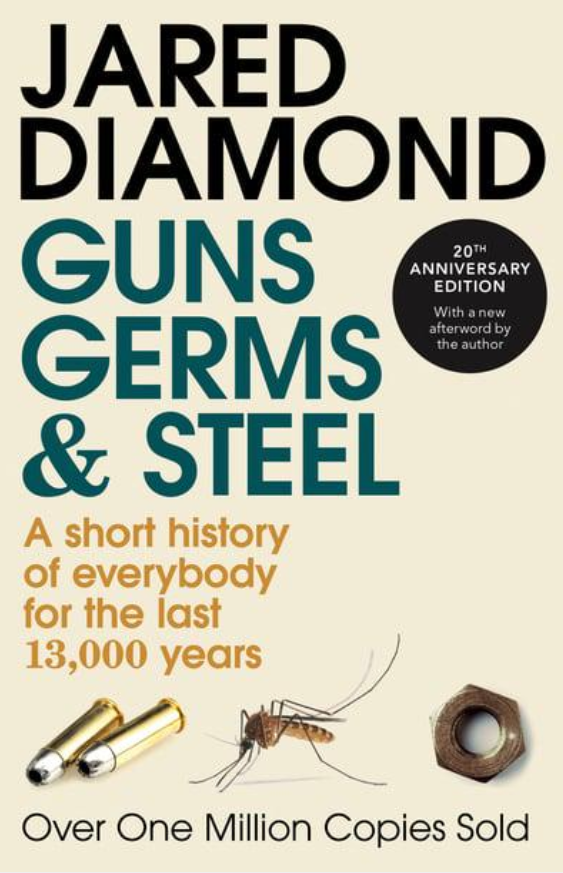
Guns, Germs, and Steel: The Fates of Human Societies by Jared Diamond

My rating: 4 of 5 stars

A must-read for anyone puzzling over why there appears to be so much inequality in the world. I wouldn’t say it lets warmongers off the hook, but I won’t look at a map of the world again without acknowledging Diamond’s wide v tall continent theory.

In summary: To build an empire, put a man on the moon, invent the internet or find a cure for cancer, one needs the following:
1. Lots of healthy individuals with plenty of spare time on their hands which requires:
2. Not having to hunt/gather for your food which requires:
3. An agricultural revolution which requires:
4. Being born/migrating to a part of the world with plenty of edible plants/livestock/slaves to choose from which requires:
5. Living in/invading those ‘wide’ parts of the world enjoying a Goldilocks relationship with the sun, i.e. Asia, Europe and North America.

Oh, and once you’ve discovered how to smelt iron during all that spare time, make sure you travel the world in the ships you’ve invented to kill and/or enslave those still using flint tools, and the situation becomes an exponential curve of ‘progress’. What? They refuse to be enslaved? Don’t worry – living in close proximity to all that livestock means you’re now a walking biological weapon too and the less fortunate will soon be dead through disease anyway.

Don’t you just love nature?

Four and not five stars only because of Diamond’s repeated insistence ‘race’ has had nothing to do with why Africans have never conquered the world. Not because I disagree, but because he doesn’t then go on to draw the obvious conclusion – had the Sahara Desert been on the same latitude as Europe, there’s a good chance Africa would have. 

View all my reviews


Should believers be worshipping The Devil?

By | Thoughts
Be careful what you wish for…

The Boxing Day Tsunami of 2004 killed an estimated 230,000 people across 14 countries. Given many were babies or children too young to understand let alone be capable of sin, theologians generally agree this could only have been the work of The Devil.

Now, as God not only failed to stop the evil but has still yet to resurrect any of Satan’s victims, one can only assume that of the two unseen entities, the latter is by far the more powerful. Logically therefore, when it comes to ensuring one’s place both here and in the afterlife, it is The Devil we should be worshipping and not God.

Or maybe, just maybe…

Bad People

By | Thoughts

Bad people vote right and good people vote left.
And by ‘bad people’ I mean men, and by ‘good people’ I mean women.
And by ‘men’ I mean white men, and by ‘women’ I mean feminists.
And by ‘white men’ I mean capitalists, and by ‘feminists’ I mean ‘woke’.
And by ‘capitalists’ I mean fascists, and by ‘woke’ I mean activists.
And by ‘fascists’ I mean ‘terrorists’, and by ‘activists’ I mean freedom-fighters.
And as one person’s terrorist is another person’s freedom-fighter…

An interview with a fascist

By | Fiction? | No Comments

‘By her own admission, my next guest has led an unconventional life. Born into privileged American society, and educated at some of Europe’s finest finishing schools, a life of fashion shows, A-list galas, political fundraisers and other well-heeled charity events was never going to satisfy the young Karen Bradley. No, this rebellious teenager had another career in mind and one that could not have been more opposite – pounding the beat as a humble police officer. Fast-forward forty years, and today, the United Nations’ most senior policewoman commands a contingent of UNPOL moderators to the UK. And not without controversy.

Chief Bradley. Your officers’ methods are currently bringing protesters out onto the streets. How do you respond to those who say forcing people to understand opinions opposed to their own is straight from the pages of a dystopian novel?’

‘I would respond by saying: How else are we to tackle the rampant anarchy of so-called social media? The problem is not only beyond the control of the UK’s own police force but worldwide, so making the UN responsible for moderating the internet would seem to make sense.’

‘But UNPOL’s remit doesn’t just cover social media, does it? News agencies, political parties, industry, institutions, even children’s organisations. Can you not see how unsettling that might be for some?’

‘Desperate times call for desperate measures. Before the UN Security Council voted to accept the measure back in 2025, the world was on the brink of collapse and all because some bored teenager could start a war with a single tweet or post. Thanks to my officers’ interventions, that threat has all but been eradicated.’

‘But by forcing everyone to consume views opposing their own?’

‘Not ideal, I’ll admit. But it’s preferable to censoring. By ensuring both sides of a story are told, society as a whole is not only safer but better informed.’

‘Well, I can see how that could work when it comes to countering lies with the truth, but the other way around? Isn’t that not only immoral but dangerous?’

‘An unfortunate necessity. Blame Trump and Brexit. The world has never been more divided thanks to those two and if countering fake news with alternative truths saves the world, then so be it.’

‘Two wrongs don’t make a right, Chief Bradley. A lie is a lie no matter how you dress it up.’

‘Really? What colour is your tie?’

‘I’m sorry?’

‘It’s a simple question. What colour is your tie?’

‘Er, Blue.’

‘It’s green.’

‘I think I know the colour of my own tie. Aquamarine if I’m not mistaken.’

 ‘Not to someone who’s colour blind. Some sufferers would say it was green or even grey.’

‘Well, as aquamarine is a sort of bluish-green…’

‘And now, having considered the opinions of others, are we agreed? Your tie is both blue and green?’

‘I suppose so.’

‘Welcome to the world of an UNPOL moderator.’

‘I think you’ve just proven my point – your methods involve concealing lies behind the smoke and mirrors of loosely connected facts. Which brings me to my next question. What is your relationship with the King?’

‘I don’t know what you mean.’

‘Don’t be coy, Karen. Is it true you enjoy more than a diplomatic relationship with our country’s monarch?

‘It is true my privileged upbringing has allowed doors to be opened that might otherwise be closed, but I can assure you my relationship with His Majesty is innocent.’

‘Innocent? You call sneaking into Buckingham Palace at two in the morning “innocent”?’

‘We’re both busy people. Finding time for recreation is difficult.’

‘Recreation? What sort of recreation?’

‘Sex.’

‘Sex? You mean you’re having an affair with the King?’

‘Of course. And not only the King of England. The British prime minister, President Gatesberg, the Russian and Chinese premiers. Don’t you want to see the world making love and not war?’

‘Er, I don’t know what to say.’

‘We’ve just discussed how difficult it can be to settle the world and its differences. Brute force and ignorance might work in the short term, but there’s nothing like gentle persuasion for producing a lasting effect.’

‘Chief Bradley. Is this a confession? Are you saying you’re sharing a bed with more than one of the world’s leaders? Some would consider that treason!’

‘Blame the hippie commune I ran away to back in the 1970s. Taking over the world by making love and not war has always made sense to me.’

‘Don’t you mean, saving?’

‘I’m sorry?’

‘You said “taking over the world”. Don’t you mean “saving the world”?’

‘Did I? My apologies – slip of the tongue.’

What is Karen up to? Read ALT TRUTHS to find out!

Alt Truths

By | Author Interview

Five Quick Questions…

Q. Were Alt Truths to become a film, who would be your ideal actors to play Sarah and Richard?

A. I can see Karen Gillan relishing the chance to play the part of our pagan, mother-earth worshipping, anti-establishment heroine (Think Disney’s Merida and her single-minded determination – red hair too!) whereas Richard would have to be played by someone who couldn’t be more conservative if he tried. I don’t know why, but a young Harrison Ford comes to mind. How about Alden Ehrenreich?

Q. Do you have plans for a sequel?

A. I didn’t, but now Alt Truths’ reviews are starting to come in, it’s clear I’m either rubbish at endings or readers just want more! My next novel was going to be about a man unable to have children, but who then meets a teenage girl who insists she’s his daughter. Needless to say, the ‘futurist sci-fi’ nature of my genre means that would lead to all sorts of dystopian adventures while they seek the ‘truth’ and as that fits neatly in with ‘Alt Truths’, it looks as if they might have to gate-crash Sarah and Richard’s wedding along the way (or something like that!)

Q. Would you have Alt Truths become an audiobook?

A.  Already in the pipeline and should be out before Christmas. The producers are currently scouting for someone who can do male/female Cornish, American southern, Mid-Atlantic, Posh, and West African accents. A walk in the park for the likes of Jonathan Keeble (if I can get him) – check out The Condition Trilogy in the meantime – he’s awesome!

Q Have you got any other unpublished works or any underway?

A.  Other than the (probable) sequel to Alt Truths mentioned earlier, I’m hoping to make a start on my first non-fiction book. Actually, it might turn out to be little more than a paper at this stage, but I’m thinking big! If you’ve read Condition’s The Final Correction, you’ll know the main antagonist mentions a chap called ‘Glubb Pasha’. He’s a real-life hero of mine, and not just because he served as a soldier during both world wars. He wrote a paper that likened the birth and death of nations to the cradle to grave existence of we human beings, i.e. they’re born, they grow up, pick fights with the kid next door, grow up a bit more, find someone to settle down with, before having kids of their own who go on to make the same mistakes. If anything, his paper The Fate of Empires and Search for Survival is more apt today than it was when he wrote it back in 1976. Although Glubb was celebrated after WW2 (he helped make Jordan the stable Middle Eastern country it is today) his philosophy on life is underrated and I’d like to fix that.

Q.  Do you ever experience writer’s block? If so how do you counter it?

A.  Nope – next question! My problem is not writer’s block, but the rapid pace at which I write – stuff often gets left out by mistake. Here’s a typical example:

Richard opened the door.

‘What did you do that for?’ said Sarah.

‘I don’t know.’ Richard stared into the gloom. ‘I’m sure Alec meant for me to do something.’

‘Is it dark?’

‘Blank more than dark.’

Sarah tutted. ‘He’s done it again.’

‘Done what?’

‘Forgotten to finish the scene. A pound to a penny you’re currently fighting a robot in the next chapter.’

‘Oh,’ said Richard. ‘Should I put some clothes on in case he comes back?’

Sarah sighed. ‘Just get back into bed.’

Many thanks to bookwormscornerblogspot.com

Am I a war criminal?

By | Thoughts

I am expecting a knock on my door one day. A conversation will ensue during which the visitor will accuse me of being an accessory to murder. The accusation won’t come as a surprise and neither will I be able to deny the claims. For I witnessed the planning and conduct of the 2003 invasion of Iraq and did nothing to stop it.

Think my arrest unlikely? It’s nothing that wouldn’t make perfect sense to Oskar Groening. Oskar was once an office clerk who, along with the thousands of other Nazis deemed not to have blood on their hands after the Second World War, was allowed to lead a normal life. However, seventy years later he was arrested, tried and found guilty of ‘being an accessory to the murder of at least 300,000 Jews’. His crime? He happened to be stationed at Auschwitz which meant he knew of the atrocities but did nothing to stop them. The irony was if he hadn’t been such a high-profile campaigner against fascism, he probably wouldn’t have been arrested in the first place.

I share a similar sense of responsibility. When, back in 2003, it was discovered Iraq had no weapons of mass destruction I truly believed there would be no war. To say I was aghast to discover we were going to invade the country regardless is an understatement. I voiced my concerns at the time but only to be met with shrugs of shoulders and shakes of heads. In the military, you are trained to obey orders – not to question them – but that didn’t and doesn’t stop me from being troubled by what has since been euphemistically called ‘a mistake’.

The public’s attitude towards its military is changing. What was once seen as an institution to be proud of is increasingly viewed with pity today; nothing more than pawns, put into difficult and dangerous situations by misguided masters with equally dubious intentions. It’s nothing new. When I decided to join the army back in the 1970s, one of my school teachers asked me why I would want to kill people. I was stunned by his attitude. I didn’t want to kill anyone – I just wanted a job. I dismissed him as an out-of-touch hippy, but in the decades since, few would argue many more now share his concern. Who would want to kill someone? The answer of course is that no one does, but there can be no doubt fighting for one’s nation doesn’t resonate like it used to. And, if anything, society is becoming increasingly dismissive of the concept.

The word ‘nation’ has negative connotations today and to the point where it has even become linked with fascism. To many, it conjures up images of far-right organisations, proudly flying the red, white and blue as if it were a swastika. Our elected politicians share a similar discomfort – The Scottish National Party certainly regrets the n-word and as for their thoughts on the Union Jack…

But where does that leave ‘national’ organisations like the military? Like many a teenager, when I first enlisted I was just chasing a paycheck and looking to the weekends. Then, to my surprise, I found myself being honoured by Her Majesty The Queen and my chest swelled with pride. It was official. My contribution to the betterment of society had been recognised at the highest level and I willing wedded myself to the military in response. A proud servant to Queen and country – my nation.

In the UK (and I suspect increasingly so in the US), that attitude is not only ridiculed now but abhorred. Today, the only time society takes pride in itself is at sporting events. When an athlete dedicates his or her latest win to the nation, the country’s flag is waved enthusiastically in response but if a soldier, sailor or airman expresses a similar pride in their achievements, society’s reaction is tempered with a heavy dose of pity and even regret.

But if you think the passage of time isn’t about to further change the way the UK, the US (or any Western nation for that matter) views its service personnel then look at how we treat our veterans today. I may not have been serving when The Bloody Sunday Massacre took place in Northern Ireland but the fact the soldiers involved are being investigated for murder some forty-five years later comes as no surprise to me.

I’m proud to have served Queen and country but just as German society has seen fit to change its mind about someone once viewed as little more than a victim of circumstance, I suspect the passage of time will ensure my pride and that of many others will one day receive a similar punishment.

I often wonder if there was more I could have done to prevent the needless deaths of thousands of Iraqis and allied troops back in 2003 and that’s why I took to writing – to try and exorcise my sense of guilt. Oskar was ninety-three when he was arrested so I suppose I could even be dead by the time society decides my particular ‘blind eye’ was a war crime. Here’s hoping.